Cybersecurity in Accounting: How to Protect Financial Data and Reduce Risks in Your Company

In Brief:
- Cybersecurity in accounting protects financial data, systems, and processes from cyberattacks, data breaches, and unauthorized access.
- Accounting is one of the main targets for cyberattacks, and lack of security can lead to financial losses, reputational risks, and legal consequences.
- To ensure security, companies must implement risk assessments, access controls, employee training, and secure IT infrastructure.
Accounting is one of the most critical functions of a company—it processes financial data that determines the company's stability and growth. However, for this very reason, accounting is increasingly becoming a target for cyberattacks. Data breaches, payment fraud, and unauthorized access can not only cause financial losses but also significantly impact a company's reputation and trustworthiness.
But the threats are not just theoretical. Real-world examples show that even well-known companies suffer millions in losses: In 2023, the British retail company Marks & Spencer experienced a significant profit decline and hundreds of millions of pounds in costs following a cyberattack that halted operations and affected both customer data and financial processes. These incidents demonstrate that cybersecurity in accounting is not just a theoretical necessity—it is a pressing requirement for a company's stability and reliability.
What is Cybersecurity?
Cybersecurity is the combination of technologies, processes, and people that protect systems, networks, and data from unauthorized access, attacks, and damage. Essentially, cybersecurity is a company's digital defense against financial, data, and reputational losses. In recent years, with the advancement of technology and criminal networks, cyberattacks have become one of the largest economic threats in the world.
IBM's Cost of a Data Breach Report 2025 states that the global average cost of a data breach is approximately $4.44 million per incident. This clearly indicates that cyber incidents cause enormous direct costs for companies—not only IT repairs but also legal consequences, reputational losses, and operational disruptions. Latvia is also directly affected: In Q4 of 2025, the highest-ever number of manually processed cyber incidents (923) was recorded by CERT.LV, a sixfold increase since 2022, while the number of compromised devices increased eightfold, reaching a record high (731,783) during the reporting period.
Why is Cybersecurity Critical in Accounting?
Accounting is the central hub of a company where all operations and data converge. It not only provides access to sensitive data but also access to bank accounts, which are particularly valuable to cybercriminals. Therefore, cybersecurity in accounting is critically important—an attack can affect the survival capabilities of the entire company.
Accounting stores sensitive financial data:
- bank account information;
- customer and supplier payment data;
- salary and tax information;
- financial reports and budgets.
As a result of cyberattacks, not only can company funds be obtained, but also information about potential future victims—customers and suppliers. Cyberattacks can completely paralyze accounting processes: block payment systems, deny access to salary data, distort financial reports, etc.
And it's not always possible to detect an attack in time. The average time required to detect and contain a cyberattack can reach up to 277 days (IBM). This is precisely why GDPR stipulates that financial data is particularly protected and violations can cost up to 20 million EUR or 4% of global turnover. Such an example has already occurred in Latvia—in 2024, the Riga Regional Court upheld the decision of the data inspection to impose a €1.2 million GDPR fine on the company SIA "Tet" for incomplete personal data processing and negligence in data protection.
How to Implement and Ensure Cybersecurity in Accounting?
Cybersecurity is not something that an accountant can implement alone—it requires a person or outsourcing service specializing in this area. However, company involvement is also indispensable here. Let's look at practical steps to implement and ensure cybersecurity in accounting.
Assess Risks in Accounting Processes
To understand how to protect your company's data, it is important to identify internal processes and data storage locations, as well as the circle of people who can access them.
- Identify all financial data flow points: invoice processing, payment authorization, salary reports;
- Evaluate which processes are most exposed to phishing, data breaches, and fraud—use real incident examples and recommendations from Latvian companies (CERT.LV, Latvian company cybersecurity guidelines).
- Use a risk matrix: a combination of impact and probability.
Implement Strict Access Control
Once processes, data locations, and access are clear, it's time to evaluate who truly needs access and what the connection methods are.
- Grant employees access only to necessary data (principle: least privilege);
- Use two-factor authentication for bank accounts and accounting systems;
- Regularly review access rights (NIST Cybersecurity Framework).
Train Employees and Promote a Cybersecurity Culture
It's important that understanding of cybersecurity is not limited to one employee but extends to the entire company. It only takes one employee ignoring the established requirements to open the door to cybercriminals. No wonder 90% of attacks start with human error (IBM, 2025).
- Regularly conduct phishing tests and training;
- Clearly define action protocols for suspicious emails;
- Promote a culture where reporting incidents is mandatory, not punishable.
Secure Technology Infrastructure
Once it's clear where and what needs protection, cybersecurity protocols for employees are implemented, it's time to introduce various processes within the infrastructure itself. This can be one of the most complex, time-consuming, and costly processes—but it pays off in the long run.
- Use the latest updates and patch management;
- Encrypt sensitive data, including invoices and bank information;
- Regularly perform backups and recovery tests;
- Consider endpoint protection and SIEM systems for financial data.
Monitoring and Incident Response
However, it's no secret that it's impossible to protect yourself from everything. Therefore, it's important to be prepared before something happens and prevent panic in the event of an incident.
- Create an incident detection and response plan;
- Regularly monitor the performance of accounting systems;
- Document incidents and learn from them.
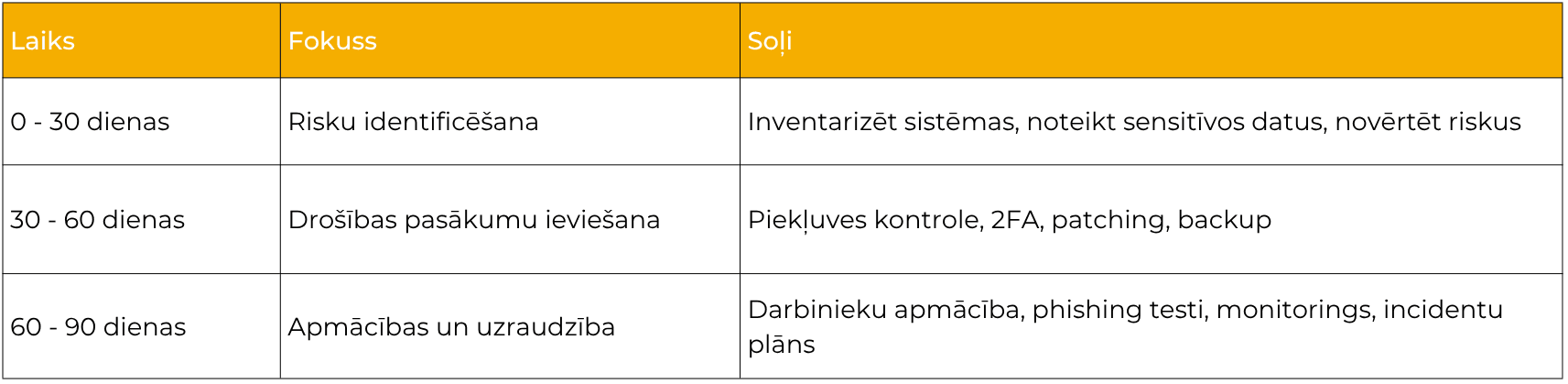
Practical 30/60/90-Day Plan for Accounting Cybersecurity
Future Perspective
Cybersecurity in accounting is not just a technical obligation—it is a strategic investment that allows a company to maintain control over its data and process security. Every invoice, payment, and financial document is a potential pathway to threats, and only a proactive approach allows a company to turn risks into confidence and stability. Careful risk assessment, adherence to access controls, and employee training create an environment where financial data is protected and business operations are secure.
Looking ahead, companies that continuously develop a cybersecurity culture gain a competitive advantage. They can not only avoid financial and reputational losses but also strengthen customer trust, maintain operational continuity, and feel confident about the security of their financial systems even in a changing digital environment. Cybersecurity becomes the foundation of sustainable development, enabling a company to grow safely and adapt to future challenges.
Frequently Asked Questions
What is cybersecurity in accounting?
Cybersecurity in accounting is a set of measures that protect financial data, accounting systems, and processes from cyberattacks, data breaches, and unauthorized access. It includes technological solutions, access control, and employee training to ensure secure financial data processing.
Why is cybersecurity particularly important in accounting?
Cybersecurity in accounting is critically important because this field processes sensitive financial data, which is a frequent target for cyberattacks. Lack of security can lead to financial losses, reputational damage, and legal consequences, making it essential for companies to ensure data protection and system security.
What are the first steps to implementing cybersecurity in accounting?
To implement cybersecurity in accounting, it is recommended to start with the following steps:
- identify where financial data is stored and processed;
- evaluate potential risks and vulnerabilities;
- restrict access to data (only to necessary employees);
- implement two-factor authentication;
- regularly perform data backups and employee training.
This approach helps gradually create a secure and reliable accounting environment.