
Warehouse
Efficient inventory tracking and management. Control the movement of goods, conduct stocktakes, and manage fixed assets within a unified system.
The capabilities your business needs


Warehouse documents and stock movement
Track every item and ensure precise inventory management. This helps small businesses organize their stock records, while providing medium-sized enterprises with transparent logistics processes and real-time stock control across multiple warehouses.
- Warehouse documents and stock movement: Centralized registration of product purchasing, sales, and transfers;
- Warehouse stock and inventory transparency: Real-time information on product availability and reservations;
- Product kitting and inventory: Creating kits from components and a simplified inventory reconciliation process.

Fixed asset management
Maintain a complete record of your company's asset lifecycle in accordance with accounting standards. Automated tools help small and medium-sized enterprises accurately calculate depreciation, avoiding errors in manual spreadsheets and ensuring up-to-date information on asset value.
- Fixed asset accounting and amortization: Comprehensive asset management from acquisition to disposal;
- Automated tracking of fixed assets and low-value inventory: Calculations and record maintenance are performed automatically, reducing the accountant's workload;
- Fixed asset list with current values: Always have access to data on residual value and accumulated depreciation.

Integrated warehouse solutions
Connect your warehouse with sales channels to ensure seamless data exchange. These integrations allow small and medium-sized enterprises to automate e-commerce order processing and logistics, ensuring accurate stock levels across all platforms.
- Electronic inventory management: Use sales and e-commerce modules for rapid data reconciliation;
- Product delivery logistics module: Integration with delivery processes for efficient order fulfillment;
- Online store module: Automatic stock synchronization between the warehouse and your online store.

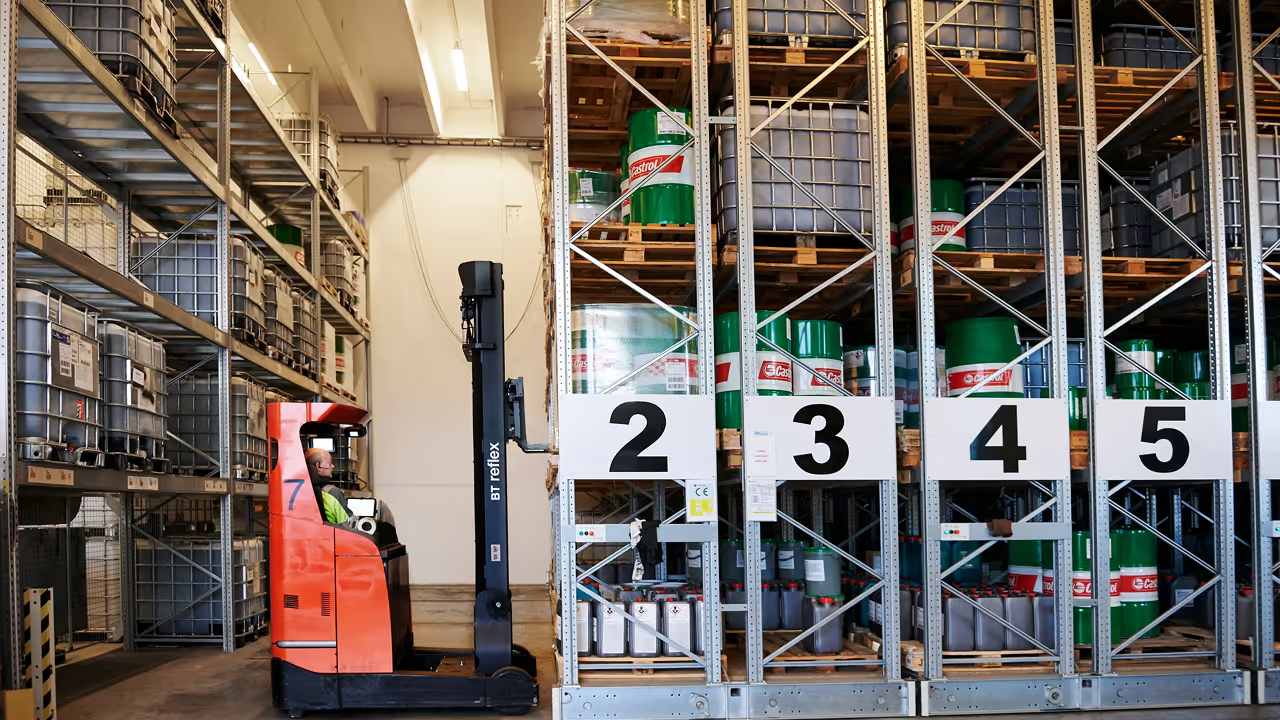
Organized warehouse and transparent inventory flow.
Comparison of Jumis and partner models
Jumis | Partner models | |
|---|---|---|
Inventory and warehouse management | – | |
Batch and serial number tracking | – | |
Expiration date monitoring | – | |
Simple assembly (single-level) | – | |
Cost and pricing management | – | |
Multi-level production recipes | ||
Production order and resource planning | IndustryTrader | |
EDI data exchange with supermarkets | ||
Integration with specialized POS systems | ||
Automatic e-store synchronization | Datateks | |
Warehouse logistics and routing | ||
Equipment rental and service history |