
Why accounting work piles up at month-end, and how to prevent overload
In brief:
- Accounting overload at the end of the month rarely occurs within a single period; rather, it accumulates throughout the entire month.
- Several critical financial processes coincide during month-end closing, making any delays in information flow particularly noticeable and placing additional strain on the accounting team.
- Timely document processing, regular financial data verification, process automation, and reducing reliance on manual tasks or a single responsible employee help to balance the workload.
For many companies, the end of the month is associated with haste, increased pressure, and intense accounting work. It is often assumed that this is normal and unavoidable. To some extent, this is true—month-end closing will always require a certain amount of work. However, in many cases, the problem is not the month-end itself.
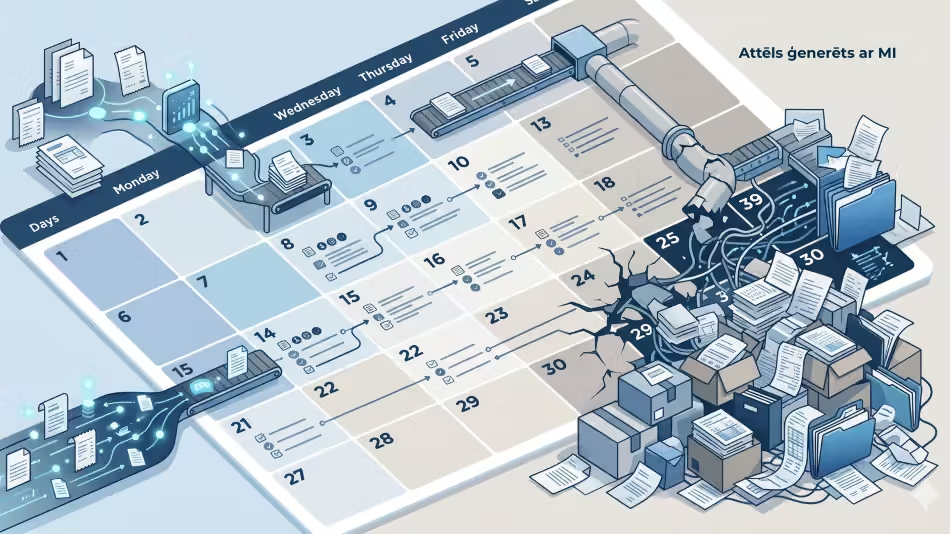
In reality, the workload rarely increases suddenly at the end of the month. More often, this is when everything that has accumulated within the company becomes visible: unsubmitted receipts, unapproved invoices, disorganized documents, unanswered questions, and deferred tasks. Therefore, month-end overload is often not just an accounting issue; it is a company process issue.
Accounting is the final link in the information chain
In many companies, month-end pressure is viewed as an inherent part of an accountant's job. In practice, however, accounting is usually the final stage in a longer information flow. Sales teams conduct transactions. Employees submit expenses. Managers approve documents. Financial specialists process payments. Only then does the information reach the accounting department.
If a delay occurs at any of these stages, it does not disappear; it simply accumulates in the system. As a result, at the end of the month, the accountant often does not receive one month's worth of work. Instead, they receive a backlog of tasks accumulated over several weeks that must be processed in a relatively short time. This is why the accounting workload is often a reflection of the entire organization's work discipline and process efficiency.
What causes the accumulation of work?
Information moves slower than money within the company
For example:
transaction occurs today → invoice is sent a few days later → approval happens even later → document reaches accounting at the end of the month.
This means that accounting does not operate with real-time information. It works with events that have already occurred. When hundreds of such minor delays coincide in one period, overload occurs.
Month-end closing combines several critical processes
Regardless of company size, a series of tasks must be completed at the end of the month that cannot be deferred to another period.
Typically, this includes:
- bookkeeping;
- bank reconciliation;
- VAT calculations;
- payroll calculations;
- accounts receivable and payable reconciliation;
- accrual calculations;
- preparation of management reports;
- analysis of financial results.
Even with modern accounting systems in place, these processes still require time, attention, and data quality control.
Manual processes create bottlenecks
Although companies are increasingly digitizing their processes, many still rely on:
- Excel files;
- PDF invoices via email;
- manual data entry;
- manual document approval;
- forwarding documents between multiple people.
Each of these additional steps may seem insignificant on its own. However, by the end of the month, hundreds of documents and manual tasks accumulate into a significant workload that must be processed within a limited timeframe.
Accounting often still operates in batches rather than as a continuous flow
Traditional accounting processes were designed for an era when data was paper-based, bank integrations did not exist, and most work was performed manually. Consequently, the entire system was organized around specific periods—months, quarters, and years.
However, modern business operates differently. Payments occur in real-time, e-commerce runs continuously, and data is generated daily. This creates a contradiction: the business operates as a continuous flow, yet many accounting processes remain organized around periodic data collection.
People naturally postpone administrative tasks
Most employees prioritize clients, sales, projects, deliveries, and other operational tasks in their daily work.
Administrative tasks, on the other hand, are often deferred:
- submitting receipts;
- approving invoices;
- classifying expenses;
- organizing documents.
While understandable, this creates a side effect: information required for accounting enters the system later than it should. Consequently, end-of-month pressure is often a result not only of financial processes but also of organizational discipline.
How can accounting workloads be balanced?
If end-of-month overload stems from a backlog of work, the solution is not to work longer hours during the final days of the month. The solution is to reduce the work that accumulates throughout the month. The sooner information reaches the accounting department, the more evenly the workload is distributed.
Shorten the time between transactions and accounting
The longer the time that passes between a transaction taking place and it being recorded in the accounting system, the greater the end-of-month workload becomes.
For example:
an employee spends money on a business trip on Monday → submits the receipt two weeks later → the manager approves it at the end of the month → accounting processes it in the final days.
In such situations, the work has existed in the system for the entire month, yet only becomes visible at the very end. To mitigate this, companies can set clear deadlines for document submission and approval.
Prevent individuals from becoming a bottleneck
Very often, the speed of the entire process depends on a single person:
- one manager approves all invoices;
- one accountant manages a specific process;
- one employee enters all documents;
- one person controls payments.
While this may seem acceptable when the volume of work is low, such processes become a significant obstacle at the end of the month.
Therefore, the most effective finance teams:
- delegates responsibilities;
- standardizes processes;
- documents knowledge;
- reduces dependency on a single individual.
The end of the month should not be the only control point
In many companies, problems are only discovered at the end of the month:
- missing documents;
- mismatched amounts;
- errors in entries;
- approvals not completed.
This automatically triggers a crisis mode. Conversely, in companies with a more consistent workflow, control is continuous. Bank records are reviewed regularly, accounts receivable are monitored daily, and data is verified during the process.
Automation reduces the workload that accumulates at the end of the month
A large portion of the end-of-month burden arises not from complex financial tasks, but from repetitive manual operations. Documents are passed between people, data is entered into multiple systems, and information is copied and verified repeatedly.
This is precisely why more and more companies are using:
- bank integrations;
- e-invoices;
- document digitization;
- automated approval workflows;
- integrations between business and accounting systems.
The fewer manual tasks required on a daily basis, the less work accumulates by the end of the month. The goal is not to eliminate month-end work entirely, but to ensure that the majority of tasks are completed before the month-end closing process begins.
Month-end overload in accounting is often accepted as a normal part of business operations. However, in most cases, it is not inevitable. It is usually the result of processes where information reaches the accounting department with delays, documents are submitted at the last minute, and controls are performed only periodically.
Companies that manage to shorten the time between transactions and their recording, automate routine processes, and implement regular data verification throughout the month gradually reduce their month-end workload. As a result, the accounting team spends less time in crisis mode and can focus more on data quality, financial analysis, and supporting business growth. The more evenly the flow of information is organized within a company, the less work accumulates at the end of the month, and the more efficient the entire accounting process becomes.
Frequently Asked Questions
What is month-end closing in accounting?
Month-end closing is the process during which a company compiles and verifies all financial data for the relevant month. This includes journal entries, bank reconciliations, payroll calculations, VAT accounting, accounts receivable and payable verification, and the preparation of management reports. The purpose of month-end closing is to provide an accurate picture of the company's financial position.
How can the accounting workload be reduced at the end of the month?
To reduce month-end overload, it is essential to process documents and financial data regularly throughout the month. Automation, bank integrations, electronic document workflows, and clear internal company processes help ensure this. The fewer tasks that are deferred until the month-end, the more balanced the accounting workload becomes.
Why do delays occur in company accounting processes?
Delays most often occur when documents are submitted late, invoices are not approved in a timely manner, or the company's financial processes are overly dependent on a single individual. Manual data entry and insufficient system integration can also cause issues. As a result, information reaches the accounting department with a delay, and a large portion of the work becomes concentrated at the end of the month.