E-invoices in Latvia 2026: expert insights, XML standards, and practical steps
In brief:
- A PDF is not an e-invoice: A PDF received via email is merely a "digital photograph" of a paper invoice. A true e-invoice is an XML file that accounting systems read automatically, eliminating the need for manual data entry.
- Automation prevents errors: Structured data is validated "at the gate." If an invoice contains a mathematical error or incorrect details, the system rejects it automatically, protecting the business from erroneous payments.
- Processes are more important than IT: A successful transition begins with streamlining internal company processes (such as establishing digital approval workflows) rather than simply installing new software.
- A digital passport in Europe: By using the PEPPOL standard, Latvian companies become compatible with the entire European business environment, ensuring fast and secure data exchange on an international scale.
Implementing e-invoicing is not merely a transition from paper to PDF, but a leap toward "smart accounting," where data exchange occurs automatically, accurately, and without human intervention. By organizing internal processes and system compatibility today, a company transforms a mandatory state requirement into its greatest tool for efficiency and international competitiveness. This is a story about a shift in mindset: from manual data entry to a transparent, secure, and European-standard business ecosystem.
Digitalization in business is no longer just an option—it is a necessity, as confirmed by the webinar "E-invoices 2026: From Requirement to Daily Workflow" hosted by Jumis Pro.
The biggest myth: A PDF file in an email is an e-invoice
Many entrepreneurs still believe that a PDF file received via email is an e-invoice. During the March 12th webinar, representatives from the State Revenue Service (VID) debunked this myth very directly:
"A PDF file in an email is not an e-invoice—it is just a digital photograph of a paper document."
A true e-invoice is a structured XML (eXtensible Markup Language) file—it acts like a digital form where data is organized in a strictly defined structure that any modern accounting system can understand.
Why is this critical?
- Validation at the gate:A structured XML file (based on the European standard LVS EN 16931-1:2017) contains algorithms that verify data before it enters your system. If the IBAN account specified in the invoice is not registered or the VAT calculation is mathematically incorrect, the system automatically rejects the invoice.
- Eliminating the human factor: Accountants no longer need to "sift through" illegible PDF scans. In an XML file, every data field has its own "digital label," ensuring that the software never confuses an invoice number with a VAT amount. Data flows directly from one company's system into another's without any manual intervention.
What needs to be done BEFORE implementing e-invoicing?
Customer experience shows that the biggest challenge is not the complexity of IT systems, but changing habits within the company.
"Implementing e-invoicing is not an IT project, but a change in mindset: success lies not in the software, but in the ability to reach agreements with partners and streamline internal processes."
- Digital transformation of approval chains: If invoices were previously signed physically by a department head, this process must now take place within the software. Experts recommend implementing an electronic workflow to ensure e-invoices do not get stuck halfway.
- Supplier audit: Contact your top 20 suppliers. Are they capable of sending structured e-invoices? If not, an e-invoicing operator can act as a converter, but the goal is pure XML exchange.
- System compatibility: Check whether your accounting software is connected to an e-address or a PEPPOL access point.
"Digital postmen" and security: How does data travel?
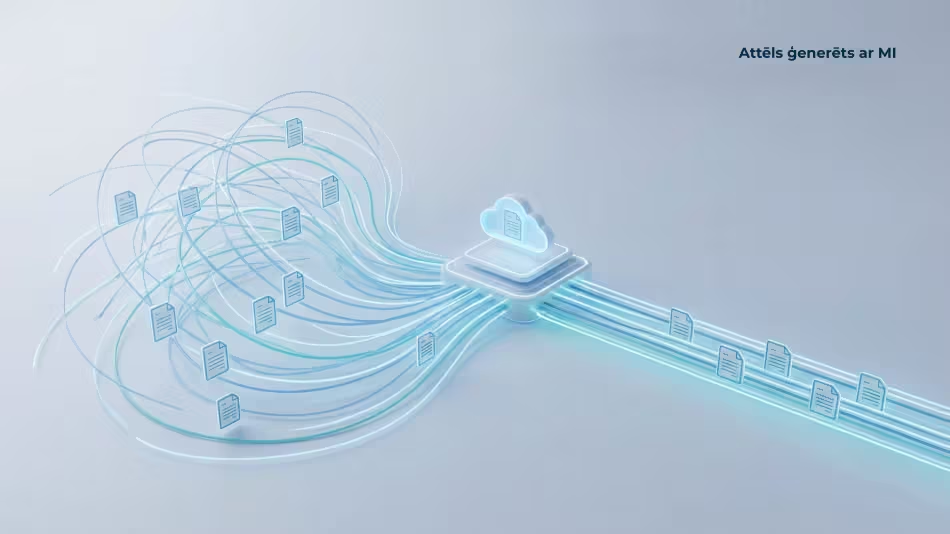
E-invoicing operators are not just intermediaries; in the webinar, experts explained the role of e-invoicing operators: they act as "digital postmen" that ensure secure data flow and verification between the sender and the recipient.
- Secure channel: Unlike email, where an invoice can be intercepted or forged (so-called man-in-the-middle attacks), e-invoicing operators provide encrypted data transmission.
- Archive as the original: It is essential to understand that an e-invoice is an original document. Experts emphasize: "Accountants do not need to print them or additionally save them as PDFs 'for safety' - systems and operators provide a legally compliant archive that is available at any time."
SRS and compliance: towards automated declarations
The strategic goal of the SRS is the transition to fully digital and transparent data exchange, which makes life easier for honest entrepreneurs.
An e-invoice is not just a new format to send via email; it is a transition to "smart accounting," where data exchange between businesses and the state occurs automatically, eliminating the manual processing of VAT reports.
What does this mean in practice?
- VAT Declaration Annex 1: In the future, thanks to structured data, this annex could be filled out automatically using e-invoices received within the system.
- Curbing the shadow economy: Real-time data exchange allows the authorities to identify fraudulent schemes instantly, rather than after receiving quarterly reports. This means fewer audits for honest entrepreneurs.
A digital entry ticket to Europe
LIKTA and industry visionaries have emphasized that e-invoices are the new benchmark for the competitiveness of Latvian companies.
"E-invoices are not just an accounting change, but a digital 'entry ticket' for Latvian companies into the modern European business ecosystem, where speed and data quality are the primary factors of competition."
By using the PEPPOL network, a Latvian company can send an invoice to any partner in Europe as easily as to a local neighbor. There is no need to adapt to each country's local "quirks" – everyone speaks the same digital language.
Why implement e-invoices today?
The webinar concluded with a powerful summary of why this transition is necessary right now:
"E-invoices are not an administrative burden; they are the digital evolution of accounting, where system automation turns a mandatory requirement into real-time savings."
In addition to time savings, entrepreneurs highlight data transparency. Managers can more easily track cash flow in real-time because invoices no longer get stuck in employees' emails but are immediately visible in the system. Since e-invoices will become a mandatory requirement in the B2B sector starting in 2028, and because organizing and implementing these processes requires time and training, experts emphasize that companies should check their system settings in a timely manner and collaborate with software providers (such as Jumis or Horizon) to ensure successful data exchange.
A practical checklist for your company:
- 1. System check: Does my accounting system support XML, and is it updated to work with it?
- 2. Choosing an operator: Which "digital postman" will handle my data?
- 3. E-address activation: Is my company reachable on the national digital network?
- 4. Internal policy: Have we defined the new approval procedure for e-invoices?
Listen to all recordings of the webinar "E-invoices 2026: From Requirement to Daily Workflow" here.
Don't wait until the last minute—connect your e-invoicing solution now: Jumis Envoice!
Frequently asked questions about e-invoices
Does a PDF invoice received via email count as an e-invoice?
No, that is merely a visual representation. Although a PDF is a digital file, it is not structured. This means that an accounting system cannot "read" it without additional tools or manual data entry. A true e-invoice is an XML file where data is tagged with specific labels. This allows data to flow automatically and error-free from the seller's system into the buyer's system. A PDF is intended for human eyes, while XML is for system automation.
Why do I need an e-invoice operator?
An operator acts as a "digital postman" and a security filter. Unlike standard email, an operator provides:
- Validation: Verifies that the invoice complies with European standards and contains no mathematical errors before it reaches the recipient.
- Secure channel: Data is transmitted via encrypted networks (such as PEPPOL), eliminating the fraud risks associated with email.
- Interoperability: The operator "translates" data between different accounting programs, ensuring that Jumis can communicate with Horizon, Moneo, or any other system.
Do I still need to print invoices or save them as PDFs for my archives?
No, that is unnecessary and even discouraged. A structured e-invoice is an original document with full legal standing. According to the experts in the webinar, e-invoice operators and accounting systems provide secure cloud archiving that meets legal requirements for document retention. Printing only creates unnecessary paper clutter and increases the risk of errors by breaking the link to the digital original.