
Is manual accounting really cheaper for your business?
In brief:
- Manual accounting is not always more expensive, but as a company grows, hidden costs increase as well.
- Digitalizing accounting is not just about cost reduction. It enables a company to process a higher volume of documents without hiring additional administrative staff and ensures better process scalability.
- The greatest value of digitalization lies in faster access to financial data and higher-quality decision-making.
Many business leaders are convinced that their accounting processes are working well. Invoices are processed, payments are made on time, reports are prepared, and financial data is available when needed. At first glance, there are no problems.
This is precisely why accounting digitalization often ends up at the bottom of the priority list. Compared to sales, customer acquisition, or new product development, automating financial processes rarely seems like an urgent matter.
However, this approach hides a significant risk. Most companies know very well how much their accounting software, outsourcing provider, or financial specialist's salary costs. Yet, it is much rarer for companies to be able to answer a seemingly simple question: how much does their accounting process actually cost?
Not the person. Not the system. The process.
How long does it take to process a single invoice? How many people are involved in document approval? How often is information entered more than once? How many hours per month are spent searching for documents, clarifying information, or correcting errors?
As long as these questions remain unasked, manual processes seem inexpensive. And in some cases, they truly are. For a company with a low volume of documents and simple processes, a manual approach may be perfectly sufficient. However, the situation changes the moment the company grows. As the number of documents, the customer base, and the demand for real-time financial data increase, the hidden costs of manual processes begin to rise.
Why does manual accounting seem cheap?
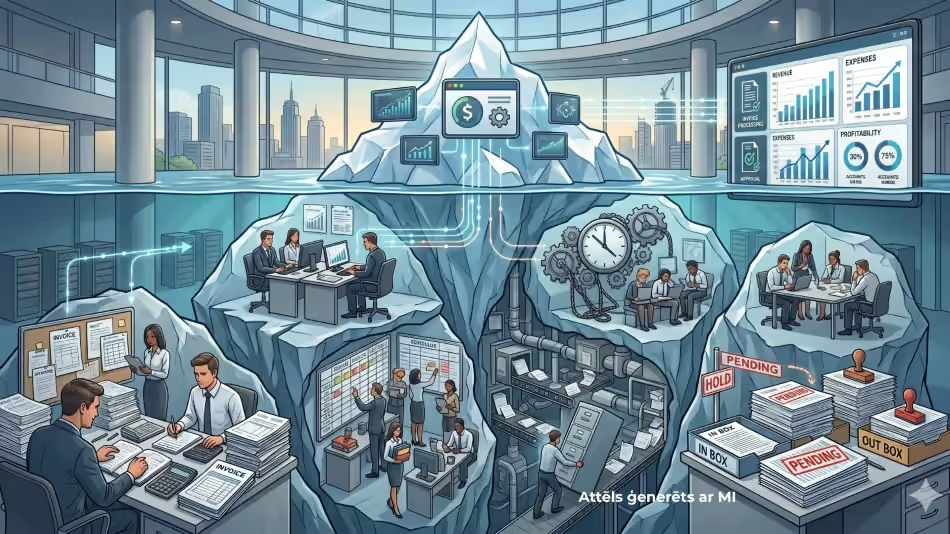
One reason is that costs are scattered throughout the organization. No budget line item shows an entry for "lost time." Nor is there a separate category for "duplicate data entry" or "manual document approval."
For example, an incoming invoice is received via email, someone forwards it to a colleague, someone checks the information, and someone approves it. Then, the data is entered into the system, the document is saved in an archive, and later used for reports. None of these actions take much time individually. However, if a company processes hundreds or thousands of documents per month, the total time consumed becomes significant.
Various studies on financial process efficiency indicate that manual processing of incoming invoices can take anywhere from a few minutes to 15 minutes or more, especially in cases involving document approval, data entry, and information verification. This means that even seemingly small tasks, when repeated hundreds of times a month, create a substantial administrative burden for the company.
Assume that the full processing of one invoice takes an average of 8 minutes. For a company processing 1,000 invoices per month, this amounts to more than 130 working hours per month. Over a year, that is more than 1,500 hours. That is almost a full working year for one employee. If we assume that the total cost of one administrative or accounting employee to the company is approximately 1,800–2,500 EUR per month, supporting this volume of work can cost the company more than 20,000 EUR annually. And that is just one process.
How do manual accounting processes limit company growth?
Traditionally, accounting automation is presented as a cost-reduction project. However, today that is no longer the main argument. A much more important issue is the company's ability to grow.
In reality, companies should ask themselves a simple question: if the volume of documents were to double tomorrow, would we be able to process it with our existing team? If the answer is "no," then the problem is likely not the number of employees. The problem is the scalability of the process.
One of the most significant advantages of digitalization is the ability to decouple company growth from the increase in administrative costs. As a company grows, the number of people entering data, forwarding documents, and checking information does not necessarily have to increase. Many of these tasks can be automated.
Therefore, companies that digitalize their financial processes often gain not only lower costs but also greater capacity. They are able to process a higher volume of documents without a proportional increase in administrative staff.
Why is up-to-date financial data more important than avoiding errors?
When discussing manual accounting, the risk of error is frequently mentioned. While valid, the real issue lies elsewhere. The primary problem is the accessibility of information. Managers require current data to make informed decisions. They must be able to understand how costs are changing, what the cash flow looks like, which clients are the most profitable, and where risks are emerging.
If it takes days or weeks to obtain this information, the company loses its ability to react quickly. This is a category of cost that is almost impossible to measure accurately. It is not caused by incorrectly entered numbers or lost documents; it is caused by missed opportunities. In a competitive environment where the speed of decision-making is increasingly critical, such a delay can cost far more than correcting a single incorrectly entered invoice.
Why is accounting digitalization a business issue?
Ten years ago, digitalization was often viewed as a technological project. The focus was on system costs, implementation timelines, and technical requirements. Today, the situation has changed. Labor costs continue to rise, and attracting qualified financial professionals is becoming increasingly difficult. At the same time, the volume of documentation and the need for real-time information are growing.
Under these conditions, the question is no longer whether a company wants to use modern technology. The question is how the company plans to develop in the coming years. If a company's growth requires an ever-increasing number of people to handle administrative tasks, it becomes a long-term competitiveness issue.
Conversely, companies that invest in accounting automation, the digitalization of financial processes, and the use of e-invoices gain a distinct advantage. They are able to grow more efficiently.
How do you know if your company is ready for digitalization?
Many managers ask the wrong question. They ask, "Do we need digitalization yet?" It would be much more useful to ask, "What signs indicate that our current processes are beginning to hinder the company's development?" These signs are usually quite easy to spot.
- The volume of invoices is growing faster than the team's capacity.
- Financial data is not available quickly enough.
- Document approval is regularly delayed.
- Employees are spending more and more time on administrative tasks.
- Management cannot obtain the necessary information without manual data compilation.
If even a few of these signs are present in a company, the question of digitalization is no longer theoretical. It is a matter of business efficiency.
Company leaders often think about growth in terms of customers, sales, or market share. However, behind every successful company are the processes that support that growth.
Want to learn more about accounting digitalization?
Read our blog:
- How should a small business manage its accounting: software or an accounting firm?
- What is an e-invoice?
- On-premise, cloud-based, or web solution – what is the difference?
- Cloud solutions in accounting: benefits and security
Frequently asked questions
Is manual accounting always more expensive than digitized accounting?
No. For companies with a low volume of documents and simple processes, manual accounting can be perfectly sufficient and economically justified. However, as a company grows, along with the number of documents and the need for real-time financial data, maintaining manual processes becomes increasingly time-consuming and costly.
How do you know when it is time for a company to digitize its accounting processes?
Typically, several signs indicate this: the volume of invoices increases, document approval takes too much time, financial data is not available quickly enough, and employees spend more and more time on administrative tasks. If the volume of processes is growing faster than the team's capacity, it is worth considering accounting digitization.
What are the main benefits of accounting digitization?
Accounting digitization helps reduce manual data entry, speeds up document processing, and improves the availability of financial data. This allows companies to manage resources more effectively, make faster decisions, and grow without the need to significantly increase administrative staff.