
E-invoices: readiness on paper and in reality
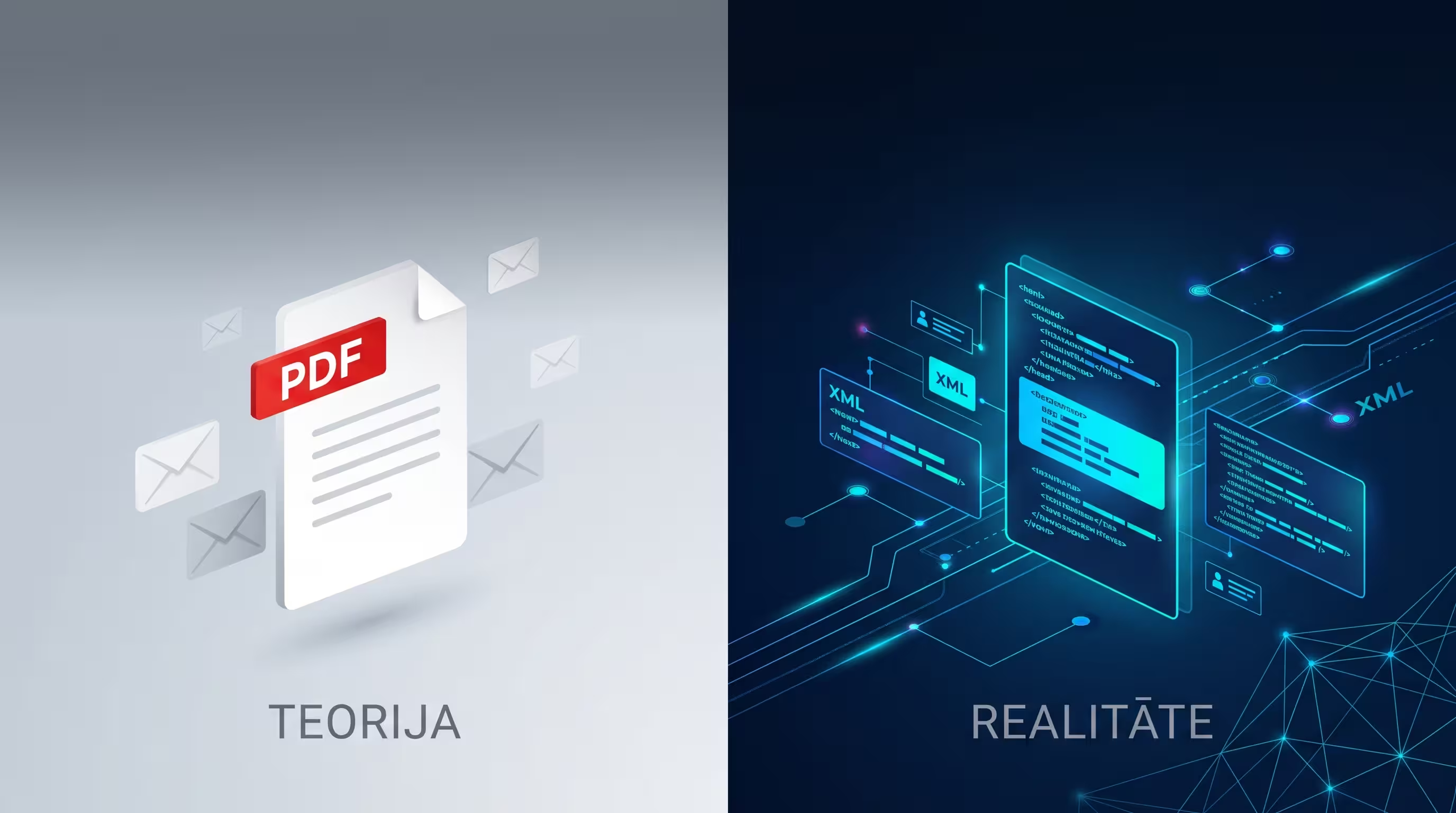
Latvian business leaders are formally aware of what an e-invoice is, but their readiness to use them is significantly lower. In a Norstat survey of 300 business leaders and financial directors, 73% correctly defined an e-invoice as a structured PEPPOL document. At the same time, 39% have not yet begun implementation, 40% are unclear about the process in Latvia, and a third see no significant benefits in e-invoicing.
In Latvia, starting from January 1, 2025, e-invoices must be used for transactions between businesses and government institutions. Furthermore, from January 1, 2028, they will be mandatory for all business-to-business transactions. Therefore, the survey results are not a reaction to breaking news, but rather reflect how entrepreneurs view the situation now that the regulations have been known for some time. However, the Latvian scenario is not unique; difficulties with e-invoice implementation are being observed across all European Union countries.
Where does the gap between knowledge and action originate? Who is responsible for implementing e-invoices—the accountant or the business owner? And does accounting software with e-invoicing functionality solve everything?
A correct definition does not mean a clear understanding
Of the 300 respondents, 219 (73%) defined an e-invoice as a document prepared in a structured format according to the PEPPOL standard. This is also the format specified by the State Revenue Service (VID): an XML file compliant with the PEPPOL BIS Billing 3.0 specification.
However, one in five (20%) believes that an e-invoice is any invoice sent via email. Another 7% refer to PDF, Excel, or Word files as e-invoices. In total, a quarter of managers confuse e-invoices with electronically sent documents.
This also affects how we evaluate self-reported data on e-invoice usage. 46% of respondents (139) indicate that they already use e-invoices, but 33 of them (24%) define an e-invoice as an emailed invoice or a PDF, Excel, or Word file. If we only consider those who both claim to use e-invoices and define them correctly, we are left with 106 respondents, or 35%. It is likely that the actual usage of structured e-invoices is closer to this figure.
The impact of B2G requirements on usage is also visible in government data. In 2024, 778 e-invoice messages were sent via the Latvija.lv e-address, but by November 13, 2025, that number had already exceeded 460,000 (VID). This is just one channel, as the volume handled by e-invoice operators is not included, but it demonstrates how rapidly usage increased as soon as the requirement became mandatory.
A long road to readiness
When looking at data regarding how far companies have progressed with implementation, the responses are split into two parts.

A total of 47% of managers have either done nothing yet or are relying on their accounting software to solve the problem. Only 7% are in the active preparation phase.
Uncertainty is most frequently cited as the biggest challenge: 40% are not entirely clear about what the process will look like in Latvia. This is logical, given that guidelines for businesses are still being developed and clarity is lacking even at the highest levels. Technical and financial obstacles are less common: 16% indicate that their current software does not support e-invoices, 14% fear the costs, and 10% do not know how to implement them.
The second significant obstacle is motivation. In two separate questions, a similar proportion of respondents stated they see no benefits. In one instance, 33% cited this as the biggest challenge to implementation, while 34% responded that they simply do not see any benefits at all. Doubts regarding benefits are widespread rather than concentrated in a single group of skeptics.
These doubts are not limited to those who do not yet use e-invoices. 40% of non-users see no significant benefits, but neither do 27% of those who claim to already use them. Those who do see benefits most often cite faster invoice processing (30%), less manual work (25%), and simpler document workflows (24%). Only 7% mention faster payments as a benefit.
The accountant: an advisor, but not the decision-maker
Responsibility for implementing e-invoicing in companies is divided almost equally. 36% of companies will have their accountant handle it, 35% will have the manager do it, and 9% will rely on an outsourced accounting provider. Only 3% assign this role to an IT specialist, and 12% have yet to decide. E-invoices are perceived as an accounting and management issue rather than a technology project.
The accountant's role is even more pronounced when it comes to seeking information. When choosing accounting software, 57% of managers would consult their accountant or service provider. Comparing software based on features and price (31%), searching online (17%), and recommendations from other managers (16%) lag significantly behind. Social media is mentioned by only 3%.
However, the final decision remains in the hands of the manager. Only 11% would fully entrust the choice of software to an accountant. Only 19% cite an accountant's recommendation as one of the most important factors in their choice, while 70% cite ease of use and 49% cite price. Thus, the accountant is the first person asked, but their recommendation is just one of many arguments.
The manager's perspective: reports, not operational work
Managers view accounting systems as tools for control and reporting. When comparing what they do in the system now versus what they would do as managers, there is an increase in only two areas: monitoring cash flow and project execution.
Operational tasks, such as invoicing, leave management, and scheduling, remain at the same level or even decrease slightly. When choosing software, 36% of managers also cite the ability to view necessary financial reports as an important factor.
The desire to work in the system themselves is greater than the practice. 80% of managers believe that the accounting system should be used by more than just the accountant, yet only 35% say they are already using it themselves. The main obstacles are lack of time (19%), lack of knowledge (15%), and lack of desire (14%). Complexity is cited as an obstacle by only 3%, even though ease of use is the most important selection criterion. This suggests that for managers, simplicity is not a complaint, but a prerequisite.
Explaining the results: the experience of other countries
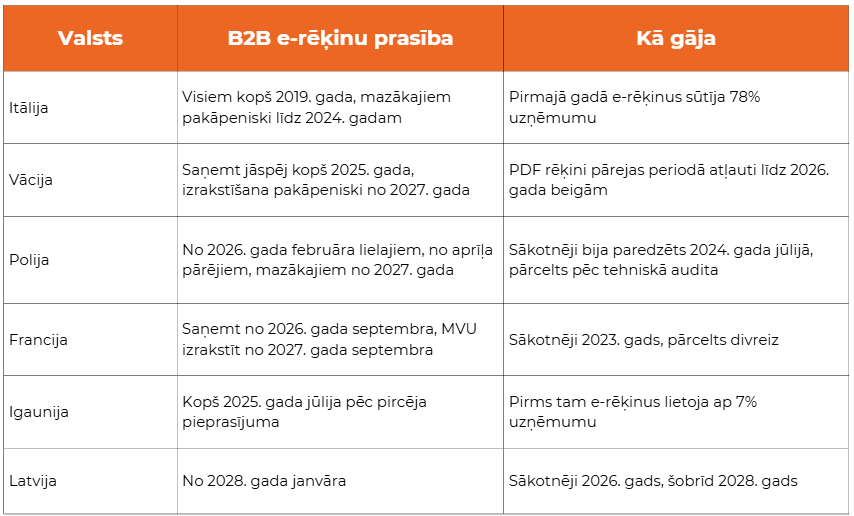
The situation in Latvia is not unique. Almost every country that has introduced mandatory B2B e-invoicing sees the same patterns repeat: e-invoices are confused with PDFs, and deadlines are postponed.
A PDF is not an e-invoice: Germany is struggling with the same issue
The German digital industry association Bitkom concluded as early as 2018 that many organizations consider a standard PDF to be an e-invoice, which is why only about a fifth of companies were able to provide structured invoice exchange at that time (Bitkom). Even at the end of 2024, a few weeks before the start of mandatory receipt, only 45% of companies were able to receive e-invoices, while practically everyone (99%) was sending invoices via email, for example as PDFs (Bitkom). Furthermore, Bitkom only surveyed companies with at least 20 employees.
The explanation most likely lies in the language. For a business owner, an invoice sent by email is already electronic, and the term "e-invoice" confirms this. The difference between a document read by a human and data read by a program is not visible in everyday life.
Postponing deadlines teaches people to wait
The experience in Poland is the closest to the situation in Latvia. The mandatory e-invoicing system, KSeF, was supposed to be implemented in July 2024, but after a technical audit, it was postponed to 2026. The constantly changing schedule made planning difficult for companies and software developers, and many smaller companies delayed preparations until the last moment because they were not convinced that the deadline would actually remain in effect (HowToPoland). Even in January 2026, nearly 80% of micro and small enterprises supported another postponement, citing complex and unclear information from the Ministry of Finance as the main cause for concern (Dziennik Gazeta Prawna, via VATupdate).</
In France, the deadline was postponed twice, from 2023 to 2024, and then to 2026 and 2027. In Germany, as late as the autumn of 2024, 72% of surveyed companies had not yet implemented the changes necessary for sending and receiving e-invoices, even though the requirement for receiving them had already come into effect in January (DLA Piper).</
In this context, the 39% of Latvian managers who have not yet started are more the norm than the exception. The nature of the obstacle is more important. 40% of managers lack clarity regarding the process, and in other countries, it was precisely unclear information, rather than a lack of time, that was the main reason for delaying preparations. The postponement to 2028 provides time, but if it is not accompanied by clear communication, it may have the same effect as in Poland: companies waiting to see if the deadline will change again.
Time is available, but clarity and motivation are not
The postponement to 2028 gives companies time, but data shows that the main problem is not a lack of time. It is uncertainty about the process and a lack of confidence in the benefits. Neither of these problems will resolve itself over time.
For companies. A quarter of managers confuse e-invoices with PDFs sent via email, so the first step is to verify whether the company is actually already using structured e-invoices. Relying on the accounting system to handle everything automatically is risky: even with a ready-made solution, processes must be adapted and agreements reached with partners.
For accountants. Managers turn to their accountants first, which is why the accountant is in the best position to reduce uncertainty and explain the benefits. The interest managers have in cash flow and project reports is an opportunity for the accountant's role to become more consultative.
For policymakers. The experience of other countries demonstrates two things. First, unclear information about the process is a stronger deterrent than a lack of time, which is why clear and stable regulations are even more important following a deadline extension. Second, the benefits of e-invoices are distributed unevenly: they are greater for the recipient and for those handling large volumes of invoices. General arguments about efficiency will not work for a small business because they will not experience them. Communication must address what will change specifically for them and acknowledge that the primary beneficiary is often the invoice recipient.
Related articles: