
Who is ready for e-invoices? Size, region, age, and gender
There is just over a year left until mandatory e-invoicing for business-to-business transactions in Latvia. The Saeima postponed the deadline from 2026 to January 1, 2028, to give small businesses and the self-employed time to prepare (Ministry of Finance). E-invoices are already mandatory for settlements with state and municipal institutions, and since January 2026, their data must be submitted to the State Revenue Service (VID).
Whether companies are ready depends on the specific company and its leadership. A Norstat survey conducted in September and October 2026, involving 300 company managers and financial directors, reveals a clear pattern. In terms of current actions, the differences are minor: the proportion of those who say they already use e-invoices is similar across all age groups, genders, and regions. However, there are significant differences in understanding, motivation, and how managers choose accounting software. The most significant divide is between micro-enterprises and all others.
Size: the gap between micro-enterprises and others
Company size is the strongest factor determining attitudes toward e-invoicing. Micro-enterprises are less prepared, more skeptical about the benefits, and implementation in these firms falls directly on the managers themselves.
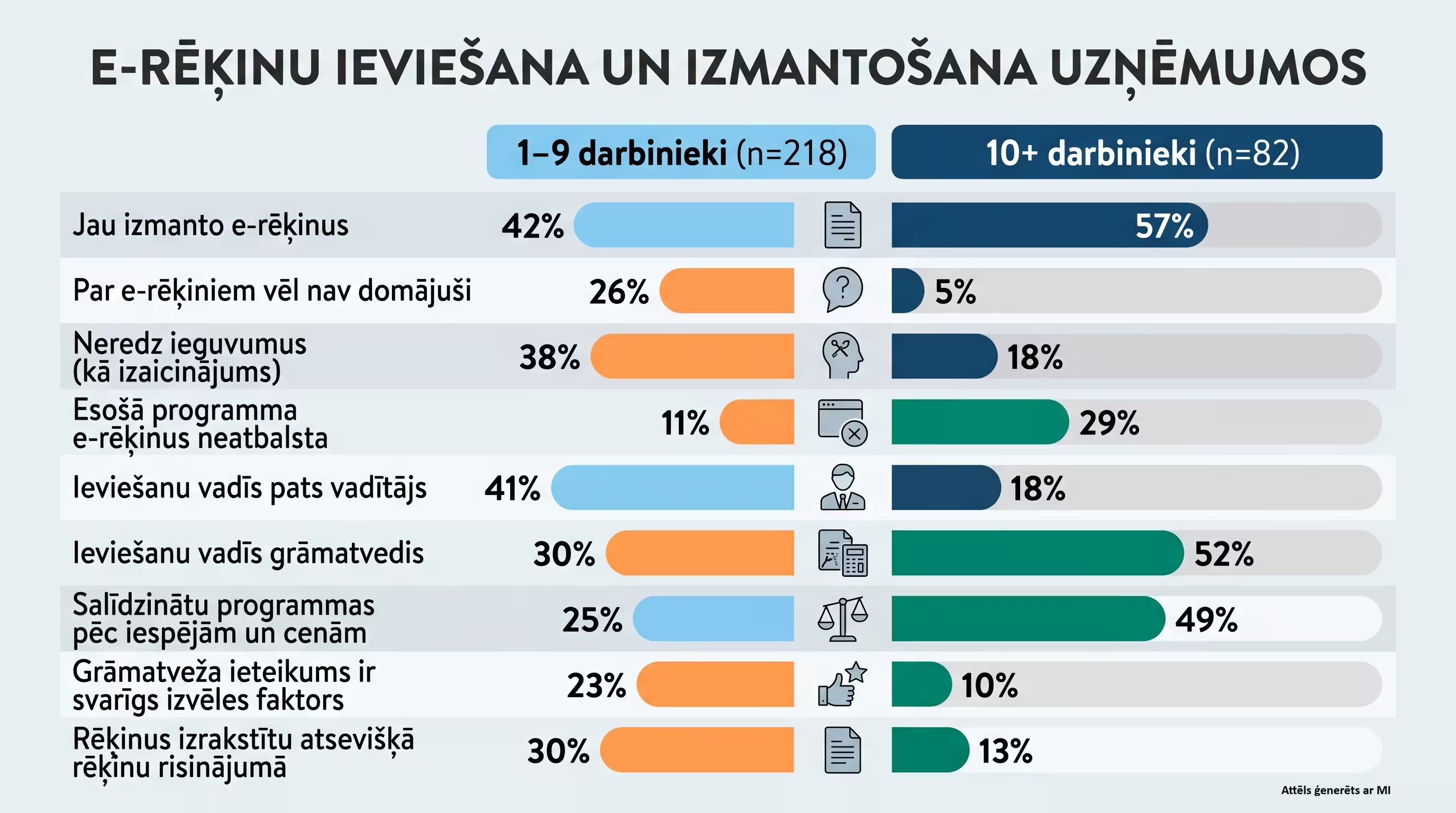
For larger companies, the obstacle is technical: one in three reports that their current software does not support e-invoices, and compatibility with other systems is a priority for 35% (compared to 15% in micro-enterprises). These results, however, do not reflect the actual capabilities of accounting software: most programs offer e-invoicing solutions, but this information does not always reach the users.
In micro-enterprises, the obstacles are motivation and knowledge. The picture is similar regarding turnover: 29% of companies with a turnover of up to 60,000 EUR have not thought about e-invoices, compared to 10% of companies with over 150,000 EUR. Smaller companies are also more likely to fear the costs (17% vs. 7%) and look for information on Google (25% vs. 10%).
The benefit is for the recipient, the work is for the issuer
Mandatory B2B e-invoicing has been in effect in Italy since 2019, and its data clearly supports the results seen in Latvia. The Politecnico di Milano research center concluded that one year after the introduction of the mandatory requirement, only a third of companies (34%) felt indirect benefits, with 40% of large companies doing so (Politecnico di Milano). 43% of SMEs saw no benefits in issuing invoices, compared to 27% of large companies (ZeroUno). The research center explains this by volume: benefits depend on the number of documents processed, and for smaller companies, this volume is lower (Politecnico di Milano).
The direction is equally important. In Italy, more than half of the companies saw benefits in receiving invoices, but only 30% saw them in issuing them (Il Sole 24 Ore). A structured invoice provides the most savings to the recipient who can process it automatically. For the issuer, it primarily means a new format. Some Italian companies even reported a negative impact, including longer payment terms (15% of large companies and 12% of SMEs) (ZeroUno).
This mechanism explains the Latvian results well. A micro-enterprise with a few invoices per month barely feels the benefit, which is why 38% do not see any. The fact that only 7% of Latvian managers cite faster payment as a benefit aligns with the Italian experience, where payments not only failed to accelerate but, for some, even slowed down. In Poland, too, 54% of small business owners believed that the main beneficiary would be the public administration, not the companies themselves (VATupdate).
Estonia has embedded this asymmetry directly into its legislation. Since July 2025, an e-invoice can be requested by a buyer registered as an e-invoice recipient, and the seller is required to comply (Sovos). The requirement is driven by the party that benefits from it.
Small businesses implement e-invoicing through intermediaries
In Italy, companies can send e-invoices to the national system themselves or entrust the task to registered intermediaries, which include both invoicing software providers and local tax consultants and accountants (commercialisti) (EU e-invoicing). Consequently, for a small business, an e-invoice can be a function of their software or accounting service rather than a project of their own.
Data from Latvia shows that micro-enterprises are following a similar path, though they have not yet reached the end. They are the ones most likely to rely on an accountant's recommendation (23% compared to 10% in larger companies) and more frequently issue invoices using a separate invoicing solution (30% compared to 13%). However, in micro-enterprises, implementation is more often led by the manager themselves (41%) rather than the accountant. Responsibility, therefore, falls on the person who sees the benefits of e-invoicing the least.
Poland also highlights the risks of this approach: before the mandatory requirement, not only were small businesses unprepared, but so were accounting firms, which also called for a postponement of the deadline (VATupdate). If the accountant is the primary channel, their readiness determines the readiness of the entire small business. In Latvia, 8% of managers believe they do not need to do anything because the system will implement itself. Experience from other countries shows that this is partially true, but only if the software provider and the accountant are prepared themselves.
Riga and the regions: "how" versus "why"
A difference is also observed between the capital and the regions. Surprisingly, 49% of managers in Riga are unclear about what the e-invoicing process will entail, while in the regions, this figure is only 28%. Conversely, those in the regions are more likely to see no benefits (40% compared to 27%). Thus, in Riga, the question is more often "how," while in the regions, it is "why."
The difference in process clarity persists even when accounting for company size, turnover, position, and the age of the managers, and it is one of the most stable findings in the entire survey. It is possible that in the capital, there is more talk about e-invoices, including conflicting information, which leads to a greater awareness that the details are unknown. The greater skepticism in the regions could be linked to the same mechanism as in Estonia: if a company's clients do not request e-invoices themselves, there is nowhere to see the benefits.
Age: each generation stands out for different reasons
Different trends are often visible when data is broken down by age group. Regarding e-invoicing, each generation stands out in different areas, and the main differences remain even when accounting for company size, turnover, position, and region.
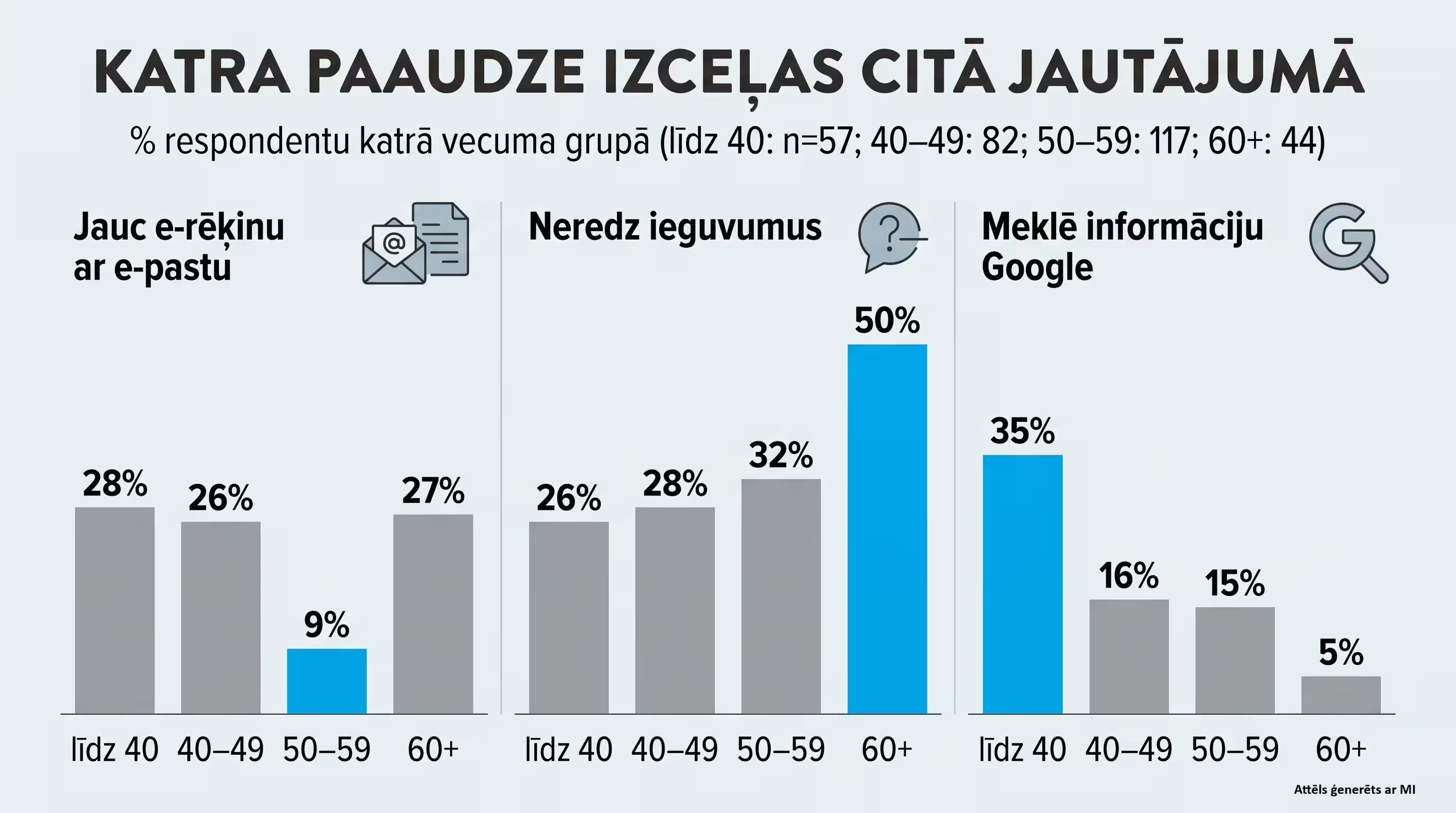
Managers aged 50–59 are the best informed. Many might assume that younger managers understand e-invoices best, but it is this specific age group that stands out. They confuse e-invoices with invoices sent via email three times less often than others, and 83% choose the correct definition (compared to 64–70% in other groups). Younger and older managers make this mistake with equal frequency, so understanding seems to be determined not by digital experience, but by direct contact with tax and accounting processes.
Managers under 40 see the benefits but work in the system less often themselves. They cite faster invoice processing as a benefit in 44% of cases, compared to 22% in the 50–59 age group. However, only 25% work in the accounting system themselves (compared to 37–39% in middle age groups), and a lack of knowledge is the obstacle they mention most frequently (25%). When making a choice, they value price the most (70%, compared to 41–46% in other groups). Young managers likely view accounting as a service to be purchased rather than work to be done themselves.
Managers over 60 are the most skeptical. Half of them see no benefits in e-invoices. Only 14% compare software, and 20% would entrust the choice entirely to their accountant. This group is small (44 respondents), so the results should be viewed as a trend.
Gender: women are more calculated in their software selection
Regarding attitudes toward e-invoices themselves—namely understanding, readiness, and assessment of benefits—there is no difference between men and women. The difference emerges when it comes to choosing accounting software.
Female managers are more likely to evaluate price (59% vs. 40%) and financial reports (42% vs. 29%) when making a choice, and they compare software based on features and pricing more frequently (38% vs. 25%). The primary explanation could be that women in this sample more often lead companies with lower turnover: 30% of female-led companies have a turnover of up to 25,000 EUR, compared to 17% of male-led companies, even though the number of employees in both groups is similar. However, the differences in selection persist even when accounting for turnover, company size, position, and age.
Female managers therefore make their choices more carefully: they compare, calculate, and want to see the numbers. For software providers and accountants, this means that arguments regarding price and reporting carry more weight than might be expected.
Conclusions: one message will not reach everyone
By 2028, it will not be enough to simply remind companies that e-invoices are becoming mandatory. For the transition to be successful, it must be understood that different groups of companies and managers have different needs and face different obstacles.
Micro-enterprises often lack the motivation to implement e-invoices, and this is understandable. Experience from other countries shows that for companies with a low volume of issued invoices, the practical benefit may be smaller. Therefore, general arguments about efficiency alone will not be sufficient. Simple and convenient solutions that allow e-invoices to be issued and received within existing accounting software or with the help of an accountant—without being perceived as a separate implementation project—will gain much greater importance.
For larger companies, on the other hand, the technical and informational aspects are more critical. If a third of companies believe that the software they use does not support e-invoices, it indicates a need for clearer communication from software providers. Companies need to understand not only whether their current solution is suitable but also what steps they must take to prepare for the new requirements.
Differences are also observed across regional and demographic lines. In Riga, there is a greater need for clarity regarding the implementation process, while in the regions, there is a need for understanding the necessity and practical benefits of e-invoices. Younger managers search for information online more often, while older ones rely on the recommendations of their accountants. Meanwhile, female managers pay more attention to price comparisons and reports.
However, all these groups share one common element: the accountant, who remains one of the most important advisors on a company's financial and accounting matters. The awareness, readiness, and ability of accountants and accounting service providers to help clients choose the most suitable solution will largely determine how smoothly small businesses transition to e-invoicing.
Thus, a successful transition to e-invoices will not depend solely on technology or the implementation of regulatory requirements. It will be equally important how clearly we explain these changes to businesses and how easy it is to adapt them to daily operations.